 English
 العربية


Why 2025 will be a pivotal year for Amazon’s Zoox robotaxi division
LAS VEGAS — This year is expected to be a pivotal one for Amazon’s self-driving car unit, Zoox, as the company plans to expand operations and commercialize its robotaxi business.
Zoox plans to start offering rides to the public “very soon,” expand its operating area and “substantially” increase its fleet of self-driving cars by 2025 from the current few dozen, according to co-founder and Chief Technology Officer Jesse Levinson.
“It’s a lot of work, but we’re excited about it,” Levinson said during a 40-minute tour of Las Vegas in one of the company’s self-driving taxis. “We’re very happy with the progress we’re making.”
While some investors have lost enthusiasm for self-driving cars, Zoox’s plans are still on track, and they’re not alone, with traditional automakers such as General Motors, Ford Motor and Volkswagen having disbanded some of their self-driving divisions in recent years.
Founded a decade ago and acquired by Amazon in 2020 for $1.3 billion, Zoox has been testing its purpose-built self-driving taxis on public roads since early 2023. The company is currently testing the vehicles, which don’t include manual controls like steering wheels or pedals, in three cities: Las Vegas, San Francisco and Foster City, California, where it’s headquartered.
Las Vegas is expected to be Zoox’s first commercial market. The company hopes to launch an “early rider program” in the coming months before opening it to the public later this year. Zoox began testing in San Francisco in November 2024, and will later launch the program there, the company said.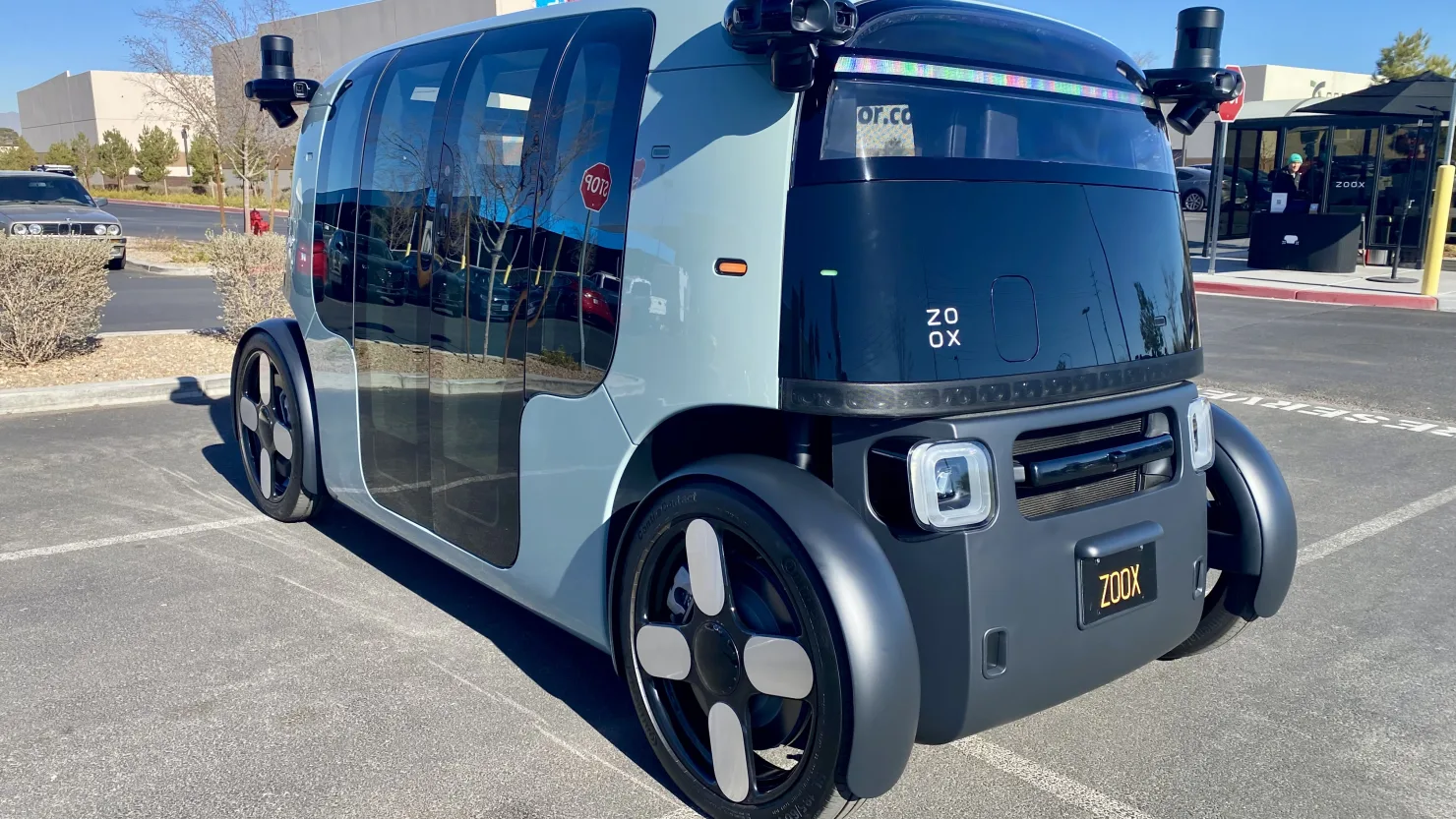
Levinson said Zoox also plans to expand to Miami, Austin, Texas and other cities, but the company has not announced a specific timeline for operating in those cities.
“Hopefully by the end of the decade, if you’re in most major cities in the United States, this will be your favorite way to get around,” Levinson said.
Amazon does not publicly disclose its investment in Zoox or other early-stage businesses, but says such investments are seen as emerging long-term initiatives to assist the company and its customers.
Take a Self-Driving Taxi
Zoox’s self-driving taxis are different from other taxis because they don’t have human drivers from the start. This is a departure from the route taken by Alphabet-backed Waymo, the U.S. leader in robotaxis, which has retrofitted conventional vehicles with self-driving car capabilities.
Some have described vehicles like Zoox’s self-driving taxis as “boxes” or “toasters.” The doors open in the middle, and seats are arranged in two rows, with no room for a driver. GM’s Cruise had also planned to launch such a car, the Origin, but canceled production after facing problems following an accident involving a pedestrian in October 2023.
“I think the vehicle itself is interesting,” Sam Abuelsamid, an autonomous driving expert and vice president of market research at Telemetry Insights, said of Zoox. “The size and shape of the vehicle are right.”
Driving on the outskirts of the Las Vegas Strip on a sunny morning, the Zoox self-driving car performed well. It turned well and drove confidently but not aggressively. There were some questionable choices along the way, such as choosing to stay in a long line instead of going around a large trailer, but overall the vehicle performed well.
Levinson said the Amazon-backed company has been working toward autonomous driving over the years of testing. Self-driving cars can’t break the law like many human drivers do, but they can’t be too cautious or aggressive, either, because that could lead to accidents or conflicts with other human drivers.
The future of the business
If Zoox can develop and begin commercial operations as planned this year, it will arguably be far behind Waymo in the field of self-driving taxis.
“I don’t want to suggest that this business will be commercially meaningful this year…but it will be very useful because customers will be able to get value from it and really use it to go anywhere. We’re excited about it,” said Zoox’s Levinson. “Because safety is paramount, we’ve taken a fairly conservative and robust approach to expansion and promotion.”
GM’s Cruise self-driving car unit was once an industry leader alongside Waymo until the company grounded its self-driving taxi fleet and announced the end of commercial operations late last year. This followed an accident in October 2023 in which an external investigation found that the company misled or deceived regulators.
Providing public ride-hailing services is just another step in the challenge of commercializing self-driving cars. Waymo began offering supervised rides to the public in Arizona in 2017, followed by unsupervised, driverless rides in 2019. The company has slowly expanded to hundreds of self-driving cars in four markets and currently provides more than 150,000 paid rides per week.
“From a technology perspective, I think Zoox is going in the right direction. I’m a little unsure about the business model,” Abuelsamid said. “The technology is maturing. It’s not perfect, but it’s getting better.
“But everyone is trying to figure out what the operating model is that will actually recoup costs and make money,” he continued.
The self-driving taxi industry has proven to be far more challenging than many imagined in the late 2010s, when GM, Waymo, Lyft, Uber and many others entered the market with grand ambitions to commercialize the technology and replace human drivers.
Companies have proven that self-driving cars are viable, but the costs have been far higher than initially expected, and the payback has taken longer than expected. Not to mention, some reports of problems on the road, and it faces uncertainty around regulations and liability.
Other companies, most notably Tesla, have announced ambitions for a self-driving taxi business, but have failed to develop driverless cars or a commercial self-driving ride-hailing business.
Meanwhile, Waymo continues to expand. Last year, the company announced an expansion of its partnership with Uber to offer its self-driving taxi service exclusively on the Uber app starting in early 2025, bringing the service to Austin and Atlanta. Waymo also expects to expand in the next few years. Expanding to Miami in early 2026.
“They are absolutely the leader,” Abuelsamid said. “They are the only company currently operating a true self-driving taxi service at any scale; they are the largest company.”
Related product recommendations:
ABB DP820
GE DS200DSPCH1ADA
Allen-Bradley 855XC-BNA10A7
ABB PM851K01 3BSE018168R1
ABB 3BHB003041R0101 UF C719 AE01
ABB 1734-SSI Encoder Input Module
Provib Tech PT2060/91
ABB 6CC3HNP02588-1
Allen-Bradley PowerFlex 755
Siemens 6ES7 135-4GB01-0AB0
Siemens 6ES7 321-7BH01-0AB0
A-B 140M-H8P-C70-PD-X
Bently Nevada 84152-01
ABB PM5032-T-ETH
Siemens Sicomp IPC f120 6AP1161-0BV00
AB PLC 759A005D-2
Motorola MVME3503
BALLUFF BTL5-E10-M0150-P-S32
GE 44A399742-G01
ITCCDO Triconex
More……